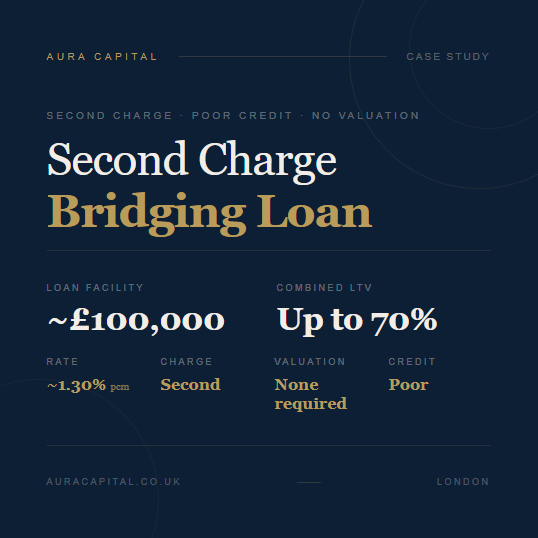
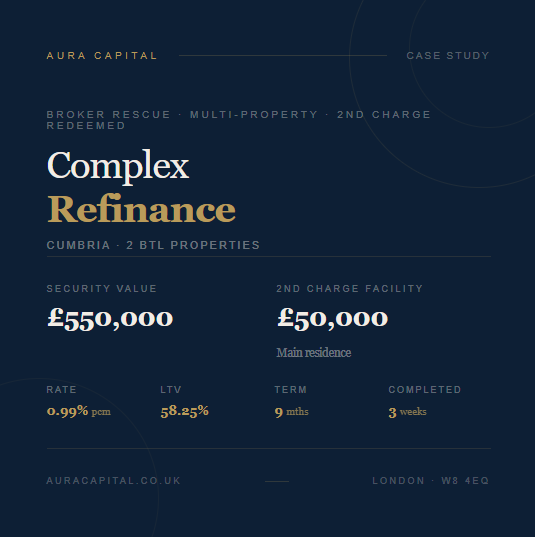
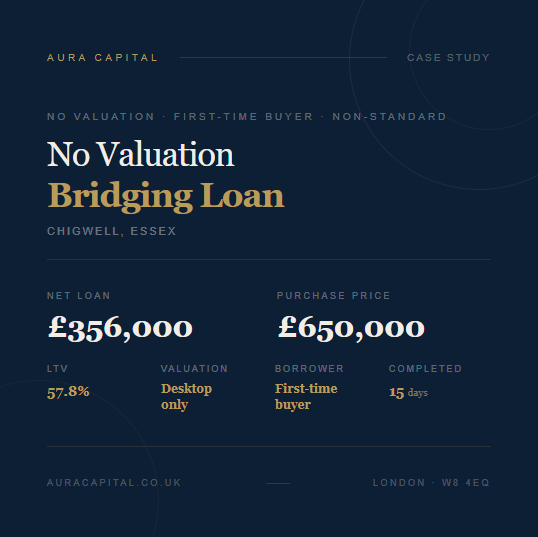
No Valuation Bridging Loans
Fast short-term property finance across England, Wales and Scotland without a full inspection valuation. No valuation bridging loans use AVM, desktop or internal valuation methods instead of a full physical inspection — removing one of the biggest sources of delay on a standard bridging case. From 0.55% per month, up to 75% LTV. Common use cases: auction purchases, refinance, chain breaks, and time-sensitive acquisitions.
What is a No Valuation Bridging Loan?
A no valuation bridging loan is short-term property finance where the lender does not require a full physical inspection valuation before offering funds. Instead, the lender typically relies on quicker alternatives — AVM bridging loans, desktop valuation bridging loans, or an internal assessment using comparable evidence and its own underwriting.
They are designed for speed and flexibility where a traditional full valuation would slow the deal down — particularly on standard properties, low-to-mid LTV cases, and time-sensitive purchases or refinances. Borrowers commonly use this route for auction finance, investment purchases and urgent refinancing, where a full valuation would add time without materially improving lender comfort.
How No Valuation Bridging Works
No valuation does not mean no underwriting. Lenders still need to be comfortable with the security, the evidence supporting value, and the planned exit — they simply reach that comfort without commissioning a full physical inspection report. Straightforward residential properties tend to fit best, while more specialist assets may need a different route such as commercial no valuation bridging, commercial bridging loans, or a full valuation-backed structure.
| Factor | Detail |
|---|---|
| Rates | From 0.55% per month |
| Maximum LTV | Up to 75% (case dependent) |
| Loan terms | Typically 3–24 months |
| Borrowers | Individuals, limited companies and SPVs |
| Use cases | Purchases, auctions, refinance, chain breaks and selected refurbishment-backed exits |
Use it when: you need to complete quickly and the property is standard enough for a lender to assess without a full inspection report. Underwriting focus: the asset, leverage and exit strategy rather than a full on-site valuation process. Typical exit: sale, refinance, bridge-to-let, or a move onto a longer-term product once the situation is stabilised.
Can I Qualify?
Most no valuation bridging cases are assessed on property type, leverage, borrower profile and exit strength. This section makes the main eligibility questions easier to scan.
Usually Considered
- Standard houses and flats
- Limited companies and SPVs
- Auction purchases
- Lower to mid-LTV refinances
- Simple titles
- Many adverse credit scenarios
Usually More Lender-Specific
- Heavy refurbishment
- Highly unusual assets
- Complex titles
- Specialist commercial property
- Second charge cases
- Weaker or unproven exits
| Question | Typical Answer | What Helps |
|---|---|---|
| Ltd Co / SPV? | Yes | Company docs and directors ready |
| Bad credit? | Often yes | Lower LTV and stronger exit |
| Auction purchase? | Yes | Legal pack and deposit ready |
| Standard residential asset? | Often yes | Good comparable evidence |
| Commercial property? | Sometimes | May suit commercial no valuation bridging |
| Heavy refurbishment? | Case dependent | May need a specialist works-based structure |
What Will It Cost?
Rates are monthly. Total cost depends on LTV, borrower profile, property simplicity, valuation route and exit strength. Pricing can vary depending on whether the lender is comfortable with an AVM bridging loan, a desktop valuation, or an internal assessment. More complex assets may be better suited to no valuation heavy refurbishment bridging, refurbishment bridging loans, or a more bespoke commercial bridging loan structure.
Low LTV, clean credit, straightforward residential asset and strong refinance or sale exit. Indicative range: 0.55% to 0.69% pm.
Standard purchases, refinances and auction cases using AVM, desktop or internal valuation routes. Indicative range: 0.69% to 0.95% pm.
Bad credit, specialist property, second charge or less straightforward exits. Indicative range: 0.95% to 1.20% pm+.
Arrangement fee typically 1.5% to 2%, plus legals and admin fees. Upfront valuation costs may be reduced versus a full inspection route.
| Term | Range | What It Means |
|---|---|---|
| LTV | Up to 75% | Higher leverage usually means higher pricing and tighter exit scrutiny. |
| Loan size | £26,000 to £10m | Higher available in some cases. |
| Term | 3 to 24 months | Should match the refinance, sale or stabilisation timeline. |
| Interest type | Retained, rolled or serviced | Retained reduces day-one net advance. Serviced requires monthly payments. |
| Arrangement fee | 1.5% to 2% typical | Often added to the facility or deducted on completion. |
How Fast?
Speed depends on the valuation route, solicitor responsiveness, document readiness and whether the deal is straightforward or specialist. The biggest advantage of no valuation bridging is that removing a full inspection report can materially reduce delay. In the right case, this can sit alongside closed bridging loans, investment purchase bridging loans, second charge no valuation bridging loans, or equitable charge bridging loans, depending on your structure and security position.
Feasibility — Same Day
We confirm whether the case is viable, the likely leverage and the most realistic lender route.
Indicative Terms — Often Within 24 Hours
You get structure clarity on pricing, interest type, valuation route and key conditions.
Legals & Underwriting Move Quickly
AVM, desktop or internal valuation routes can reduce delay compared with waiting for a full valuation inspection and report.
Completion
Strong, clean cases with quick responses complete fastest. More complex cases still need longer for underwriting and legal sign-off.
What's Required?
We keep the enquiry path simple — start with a quick qualification check, then complete a fuller pack once the case is confirmed as viable. Where the asset or scenario is more specialist, related products such as permitted development finance, land bridging loans, commercial no valuation bridging, high value residential bridging loans, or regulated bridging loans may also be relevant depending on the security and borrower circumstances.
- Name, phone, email and property postcode
- Property value and loan purpose
- Loan amount, term and exit strategy
- Company details where applicable
- Credit profile and property information
For Purchases & Auctions
Purchase price, deposit position, legal pack or sales memo, and target completion date.
For Refinance Exits
Existing debt position, property background, refinance plan and broker AIP where available.
No Valuation Bridging Loan FAQs
It means the lender is not relying on a full physical inspection valuation report. Instead, it may use AVM data, a desktop report, or its own internal valuation process to move faster.
Up to 75% day-one LTV is possible on qualifying no valuation bridging loan transactions, subject to lender criteria, property type and exit strength.
No valuation bridging loan rates start from 0.55% per month. Lower LTV and cleaner, more standard properties usually price better, while more complex or specialist cases price higher.
Yes. This is one of the most common borrower structures for no valuation bridging. Directors' personal guarantees are typically required.
Yes, often. Many no valuation bridging lenders are asset-led and will consider applications with bad credit, CCJs or defaults, subject to leverage, property strength and exit strategy.
Yes. No valuation bridging loans are commonly used for auction purchases where speed is critical and the standard 28-day completion deadline rules out slower funding routes.
Fast cases can move very quickly, especially where the asset is straightforward and the documents and solicitors are ready. Removing a full valuation can materially reduce delay.
Yes. Aura Capital is an independent, privately owned brokerage with whole-of-market access and is not restricted by a mortgage network.
Ready to Discuss Your No Valuation Bridging Loan?
Independent advice, whole-of-market access, and a clearer path from quick quote to full application. Send us the basics and get a same-day feasibility check.
Risk warning: any mortgage, loan or debt facility secured against property may be subject to repossession if repayments are not maintained. All no valuation bridging loan applications are subject to underwriting, valuation route criteria and legal due diligence, and may not be available to all applicants. Aura Capital is not a lender. We are an independent, privately owned brokerage with whole-of-market access.
Related Bridging Finance Products
Our Case Studies
Discover how we’ve helped clients secure fast, flexible funding across acquisitions, refinances, and development deals.